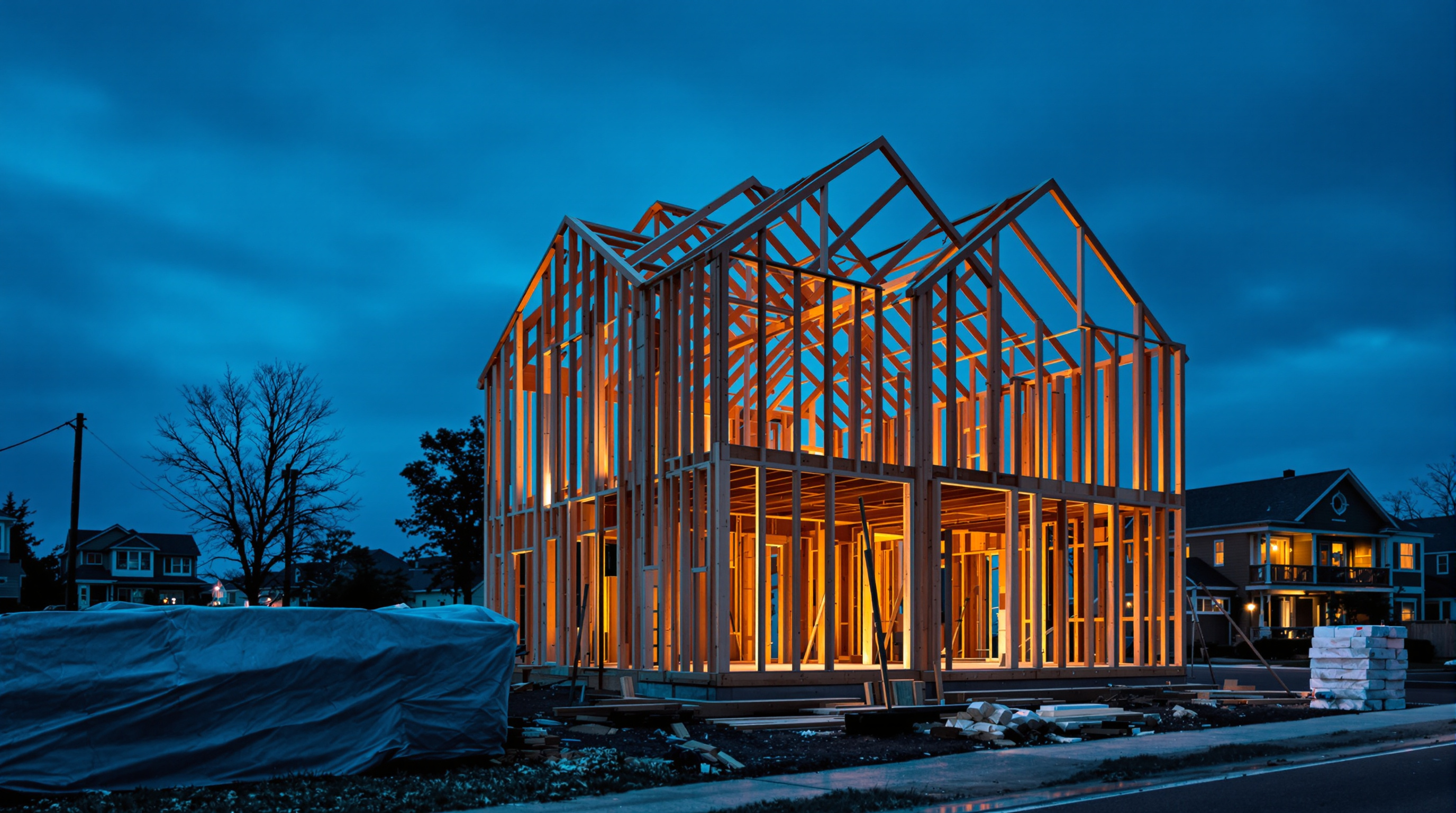
Seventeen months. That is how long residential construction employment has been shrinking year over year.
Not slowing. Shrinking. Seventeen consecutive months, a net loss of 44,200 jobs over the last twelve, and a six-month average that is still running at about 5,350 jobs lost every month.
July was technically an up month, the first in four, with residential construction adding 2,100. I would not build a Tuesday around it.
My dad's firm nearly went under in the early 2000s
Precision components, forty employees, a workshop that smelled of cutting fluid and strong tea. The order book collapsed and there was no version of the arithmetic that worked.
What saved it was not the order book. It was that his machinists took a temporary pay cut, because they had spent years watching him do what he said he would do, and they believed he would make it right. He did. I was sixteen and it is the single most useful thing I have ever watched.
The lesson is not a warm one about people being lovely. It is that trust is infrastructure, and infrastructure has to be built before you need it. Nobody builds a bridge during the flood.
Which is the whole of what I want to say about a softening labour market, so the rest of this is just the numbers.
What actually happened
The US economy lost 23,000 jobs in July, against expectations of adding 83,000. Then the Bureau of Labor Statistics revised May and June down by a combined 103,000.
Unemployment fell to 4.1%, which sounds like good news and is not. The labour force contracted by 264,000. The rate improved because people stopped looking, not because anybody got hired. Participation fell to 61.4%, the lowest since February 2021, against 63.3% before the pandemic. Temporary layoffs rose to 921,000.
Wages rose 3.2% year over year, to $37.62 an hour, the slowest pace of the year. I will be honest with you: the two sources I read disagree about whether that beats inflation. One says it does, one says it does not. I am not going to pick the one that suits my argument.
Three things this actually means for you
One. The supply is not coming
Everybody in this industry has spent three years saying the answer to the inventory problem is new construction.
The workforce that would have to build it has been contracting for seventeen months. There are 914,600 people working for builders and remodelers, down again from June. That is not a market waiting to accelerate, it is a market that has been quietly letting people go for a year and a half.
Plan for tight supply as a permanent feature of your patch, not a phase you are waiting out.
Two. Your buyer's confidence is the product
Nobody signs a thirty-year commitment the week they start wondering about their job.
Participation at a five-year low and temporary layoffs approaching a million is not an abstraction to somebody deciding whether to move. It shows up as a longer decision, more people going quiet on you after the second showing, and more deals that die between offer and closing for reasons nobody quite articulates.
That is not a market you can push harder at. It is a market where the agent who has spent two years being trustworthy gets the call and the one who has spent two years being visible does not.
Three. Do not budget on a rate cut
The instinct on a weak jobs report is that cheaper money must be coming.
The Fed held rates steady at its last meeting and three regional presidents dissented in favour of a hike. They have missed their inflation target for five years. A soft labour report probably lowers the odds of a rise, but the inflation numbers are what will decide it, not this.
Build the year that works at today's rates. If relief arrives, lovely. Do not put it in the foundations.
Have you thought this all the way through?
Here is the bit I would push on if I were sitting across from you.
Most people read a report like this and ask what it does to their pipeline this quarter. That is the wrong question, because the answer is "a bit, probably, hard to say."
The better question is what you have already built that keeps working when the weather turns. Not what you will do about it now. What is already in place, because that is the only part you get to use.
Past clients who would take your call. A database you actually own rather than one sitting inside somebody else's account. A cost of doing business that survives fewer transactions. Systems that react to a price change without a person noticing first. Reviews that say something specific about a hard situation you handled well.
None of that can be built in the quarter you need it. All of it can be built now, while the market is still forgiving enough to let you.
Any road up
I am not telling you the sky is falling. One negative month is one month, prime working-age participation actually rose, and the people who read a single print as a catastrophe are usually selling something.
What I am telling you is that the ground has been re-measured, twice, in the same report, and it came out smaller both times. Seventeen months of construction losses is not a print, it is a pattern.
So put the kettle on and go and look at what you have actually built, rather than what you have been meaning to build. My dad's firm survived on something he had already put in the bank years before he needed to draw on it, and none of it was money.